Article
The Cockpit With No Panel
Fighter pilots already see their flight data wherever they look. The price is a helmet that fights their necks. The display could live in the cockpit.
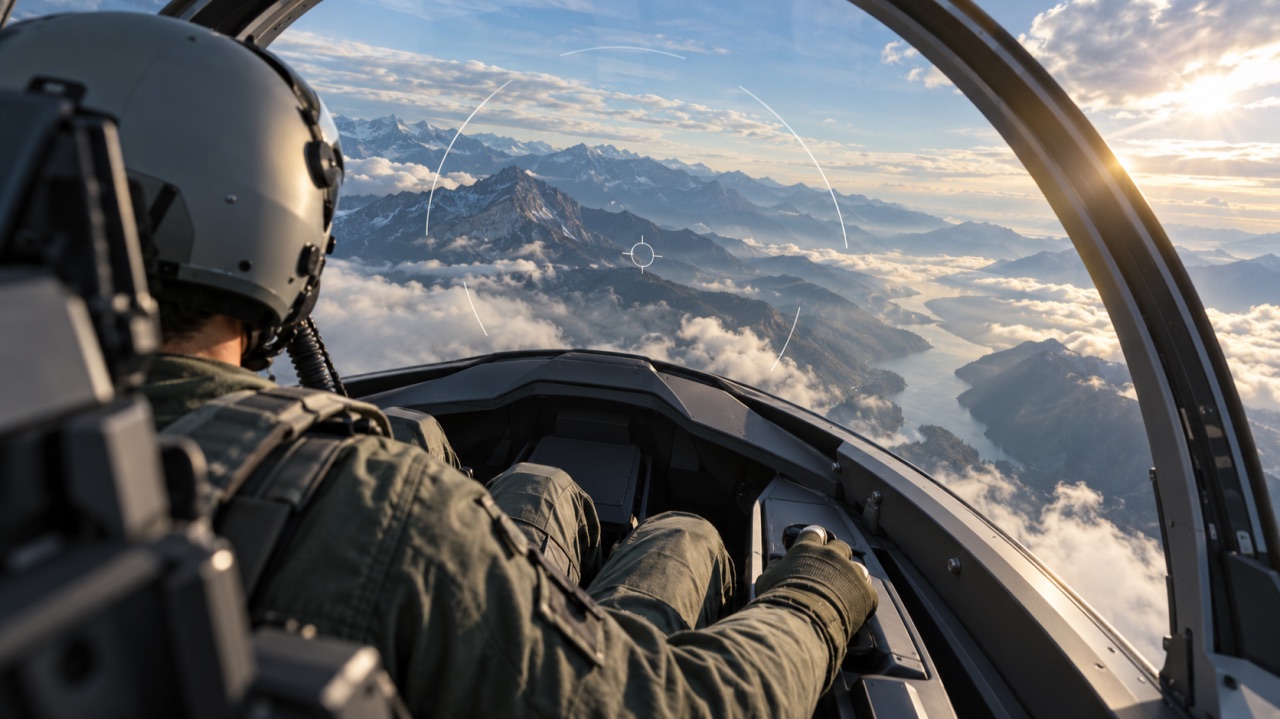
Captain Dana Reyes rolls into a hard turn at seven Gs in her jet.
Seven Gs is no walk in the park. Your body weighs seven times what it did a second ago as the blood drains out of your head and your face sags.
Reyes’s helmet already weighs about five pounds. At seven Gs, that number jumps to an eye-popping 35.
No wonder her head gets yanked down toward her knees.
She tries to keep her chin up anyway. She has to. Her helmet also serves as her instrument panel. Items like airspeed, altitude, and the target position all float on her visor. If her head sags too far, those numbers vanish with it.
Suddenly, she hears a caution tone: “Low fuel!”
As she reaches for the touchscreen, her jet bucks. Her finger comes down just below the fuel button, hitting the one beneath instead.
“How much fuel you got?” her wingman asks over the radio. He needs that number to decide if they keep fighting or go home.
“Hold on.”
Reyes tries again, but her arm weighs sixty pounds now. She misses.
To steady her hand, she must stop pulling so hard. She loosens the turn. Her finger finds the number. Too late.
A new tone fills her helmet. Missile lock.
She hears the other pilot’s voice on the radio: “Kill.”
What That Word Means
On a training range, that word would send Reyes home. In combat, she would be dead. There’s a simple reason why: Her helmet needed her head still. Her screen needed her hand still. At seven Gs she couldn’t do both.
Reyes is invented. Her cockpit misfortune isn’t.
Back in 2015, Air Force Times put the price of the F-35 helmet at an estimated $400,000. The same paper reported it weighed about 5.4 pounds, six ounces too much. A lighter pilot’s neck could be injured in an ejection.
As for that touchscreen, an F-35 pilot writing for the aviation site Hush-Kit in 2021 put a number on it: “At present I am pressing the wrong part of the screen about 20% of the time in flight.”
These problems haven’t aged out. In September 2025, the Government Accountability Office reported that testers of the F-35’s newest hardware refresh, new cockpit display included, found stability problems “including problems with radar and cockpit display systems.”
That refresh costs $1.9 billion. And it still doesn’t work right. The Pentagon’s own test office reported that of the 158 jets delivered with the upgrade through September 2025, not one was combat-capable. What if there was a safer, better way to help pilots fly?
Read on.
Where the Weight Comes From
Pilots fly with their own eyes, not through a camera.
The F-35 helmet’s job is to put numbers before those eyes. That display is what makes it so heavy and so pricey. Still, the F-35 got one thing right: information belongs where the pilot is looking. In January, the FAA’s Civil Aerospace Medical Institute had airline captains fly a 737 simulator with a display on the head and with one fixed in front of them. The one on the head raised pilot workload, making the pilots’ job harder. The mistake the F-35 program made was bolting the display to a pilot’s head.
Now, here’s my proposal.
Picture Reyes’s cockpit again, only this time with no physical panel, no switches, and no wiring. Instead, a display built into the cockpit projects the gauges and buttons into the air where she’s looking. (A new layout would be a software update, not a crew pulling panels and wiring out of the jet.)
This time when Reyes looks for fuel, the number is there and easily accessible. Buttons work the same way. They appear where she’s looking, sized big enough to hit under seven Gs and she never has to lift her hand off the armrest to press one.
And the helmet? It goes back to being a helmet.
How the Cockpit Knows
Okay fine, you might be thinking. But how does the cockpit know where Reyes is looking with no camera and no eye tracker?
Answer: her eyes tell it.
There’s science behind what I propose. Whenever you look at something, a signal travels from your eye to the part of your brain that handles sight. An EEG sensor, electrodes resting on the scalp, picks up activity there.
The software my patents describe would read that activity and tell the display where the pilot is looking. I hold nine U.S. patents on this approach, as I showed in my last article. That same piece also explains that a tumor on my optic nerves once took part of my field of vision. My brain filled the gap from the signal it already had.
If the brain can rebuild the picture, the signal carries the picture.
What Still Has to Be Solved
I won’t pretend this is built and ready to go. EEG sensors exist today. Line-of-sight displays do too. As for a full holographic cockpit?
That remains a lab project.
The software my patents cover also doesn’t exist yet. It has to read the eye’s signal cleanly in a cockpit full of electrical noise, fast enough for a fighter. Each pilot’s signal will need its own tuning. And nothing goes into a cockpit without years of certification.
Buttons Are Back
The same fight is playing out on the ground. Just this month, Euro NCAP, Europe’s car safety tester, said it has “long believed that the use of physical buttons or controls for basic functions is safer” and now rewards carmakers for them. In other words, Euro NCAP wants the button back under the driver’s hand. I want it in front of the driver’s eye.
We agree on the solution: Put the control where the eyes already are.
The Partner I’m Seeking
Captain Reyes lost a training fight because she had to choose between keeping her head still and keeping her hand still. The pilots America and its allies send into real fights face that same dangerous choice every time they fly. Some of them will lose it. When they do, the jet is the cheap part.
This is a fixable problem.
The patents are done. Now the software needs a home: a company that makes EEG headsets or cockpit displays, has a simulator to test in, and will fund the work through to a flying demonstration.
If that’s you, contact me: ofer@activepoint.com
Also published on LinkedIn.